
Leaders: stop trying to solve & do this instead
The following is an excerpt from our March 2026 issue of Hey Leader.
Hey Leader, crafted with thought & care by The Perk, is a monthly email series all with the intention to help you lead better. You belong here!




Hey, Hi! —
First, as much as I love talking about what I’m about to talk about in this month’s newsletter, can I just say…it’s REALLY hard to concentrate on any of those things when THIS is your view?

Dan & I are in Switzerland as I’m writing this, which is making it difficult to do anything except for literally gape, mouth-open at the Alps ALL the time & eat insanely good fondue & chocolate.
With that said…let’s talk about coaching.
More specifically: why coaching is one of the most powerful leadership tools you have & also why it’s one of the hardest things for leaders to actually do well.
The reason it’s hard? Well, when someone comes to us with a problem—not just as leaders, but as humans—what is usually our first step?
Yep, you’ve got it—we immediately jump into hero mode.

We solve the problem. We explain what we would do. We give the fastest path forward.
This instinct always comes from a good place. You care about the outcome & you care about your team. You want to help. Don’t we get into leadership because we…want to help?
The tricky part of hero mode is this: coaching can’t happen when you’re in it. That’s because coaching is actually an egoless activity. It requires a completely different leadership mindset—one we call the Guide Mindset.
When you shift into a guide mindset, your role changes. For one, you stop being the person that has to swoop in with the answer—because you’re empowering the other person to think more clearly, see new possibilities & move themselves into action.
Because here’s the belief that sits at the center of great coaching: That people are naturally creative, resourceful & whole. This is something we learned as our team went through the Co-Active Coaching model & it's a huge cornerstone of their approach.
People usually have more of the answers inside them than we give them credit for—sometimes they just need the right conversation, or a nonjudgemental space, or a powerful question, to unlock that magical thinking.

Okay—so we know coaching is important. And for that reason, it MUST be hard to do, right? Does it need to require a bunch of complicated techniques?
Nope, nope, NOPE. One of my favorite descriptions of coaching comes from Michael Bungay Stanier in the book The Advice Trap. He calls it “coaching in a nutshell.”
Step One: Ask a question. (Not a fake question.)
Step Two: Shut up (No, really—stop talking. I say this with all the love in the world.)
Step Three: Listen to the answer (Really listen.)
Step Four: Acknowledge the answer (not by offering advice).
Then, repeat the cycle. That’s it.
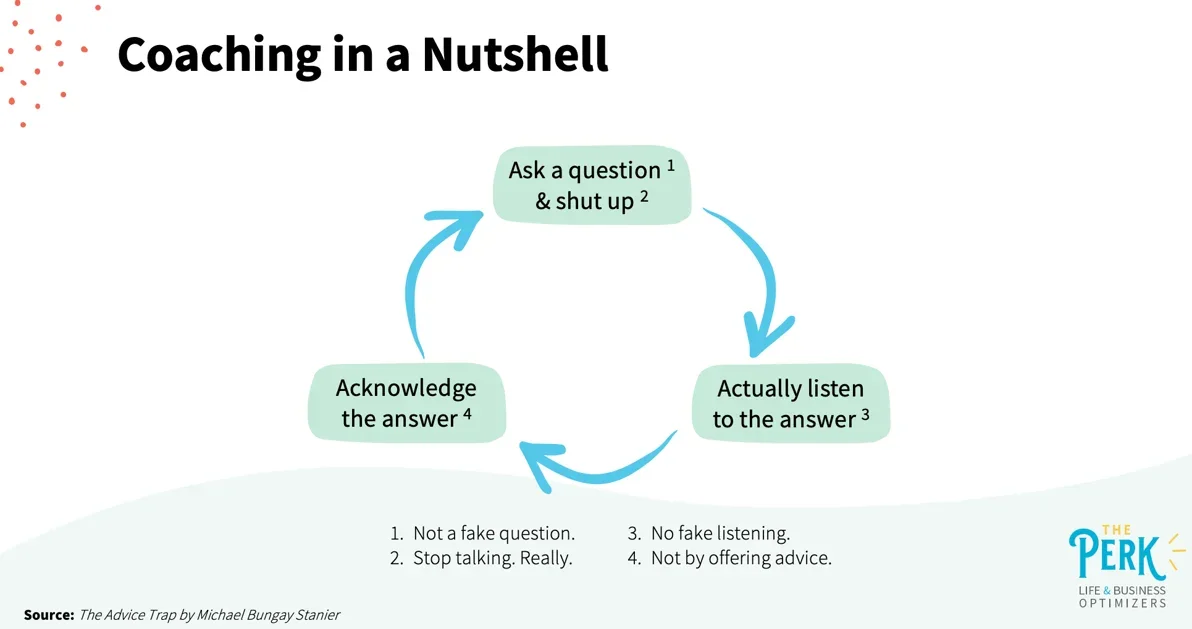
(Simple? Yes. Easy. No way! Most of us are wired to jump in with an answer about halfway through someone’s sentence.)
When leaders slow down enough to stop talking, really be an active listener, & stay curious throughout the process, something truly powerful happens: people start thinking more deeply. They start connecting the dots on their own & they start generating ideas—REALLY good ones—that they didn’t know they had.
And that’s when coaching really starts to work.
Want a little more guidance when it comes to coaching? We’ve got you in this newsletter. Read on below for a super simple structure to guide coaching conversations—called the GROW Framework.
Or, if you’re looking for a little live learning, head to this month’s Culture Community, which is all about “Coaching for Growth.” You’ll walk away ready to have clearer conversations, strengthen your teams & empower people to stretch to their potential. Learn more or RSVP here.
One more thing about coaching before I get back to staring at the Alps:
The growth that happens from coaching doesn’t always happen during the conversation. It happens after—when the other person actually processes their thinking & then goes & does something differently.
It’s a long game—but absolutely one worth playing.
You’re amazing!

Use the GROW Framework to Coach Your Team
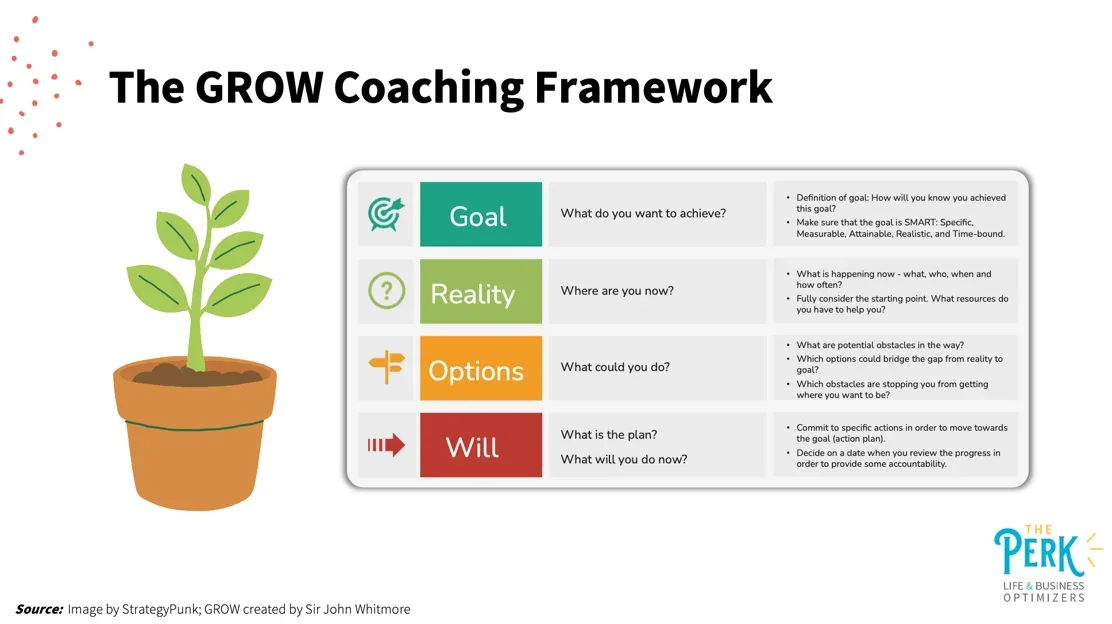
Want a simple structure for coaching conversations? Try using the GROW framework the next time a team member brings you a challenge:
Goal: Start by clarifying what the person actually wants to achieve. Without a clear goal, or definition of success, conversations can drift into venting instead of problem-solving.
Try asking: “What does success look like for you here?” or “What’s important about achieving this goal?”
Reality: Explore what’s happening right now. This helps the person step back, assess the situation & identify what’s actually getting in the way.
Try asking: “Where are you today with this?” “What’s already been tried?” or “What’s the real challenge here for you?”
Options: Now that they are clear on their ideal state (Goal) & their real state (Reality), open the conversation to possibilities. Instead of jumping in with advice, invite the other person to generate ideas & solutions.
Try asking: “What ideas do you have for moving forward?” “What else could you try?” “What might work if there were no constraints?” or even “How might your dog approach this situation?”
Will: This is the most important step—turning reflection into commitment. Coaching is more than a great conversation—it’s a conversation that leads to action.
Try asking: “What’s the best next step for you?” “When will you take that step?” or “In what way(s) can I support you or hold you accountable?”
As always, if you try this with the people on your team, we’d love to hear if it worked for you!
Teams large & small love working with The Perk!


SEE results in action!
GE HealthCare, building next level leaders.
Focus on building confident, compassionate leaders, & developing high-trust teams takes innovative, world-renowned healthcare company to the next level.

About The Perk
We're a premiere leadership & culture development studio.
The skills your leaders need today are very different from the ones they needed 5 years ago. We equip leaders with the skills they need to confidently & effectively lead their teams now & going forward.
And we have quite a lot of fun doing it!