

An accountability truth: if it lives only in your head, it’s a wish
The following is an excerpt from our February 2026 issue of Hey Leader.
Hey Leader, crafted with thought & care by The Perk, is a monthly email series all with the intention to help you lead better. You belong here!




Hey, Hi! —
Let’s talk about accountability.
I know, I know—accountability isn’t fun to talk about, right? If your shoulders immediately tensed up upon reading that word, or if you were like, “Yeah, no, Leah—let’s talk about anything else but that,” I get it.
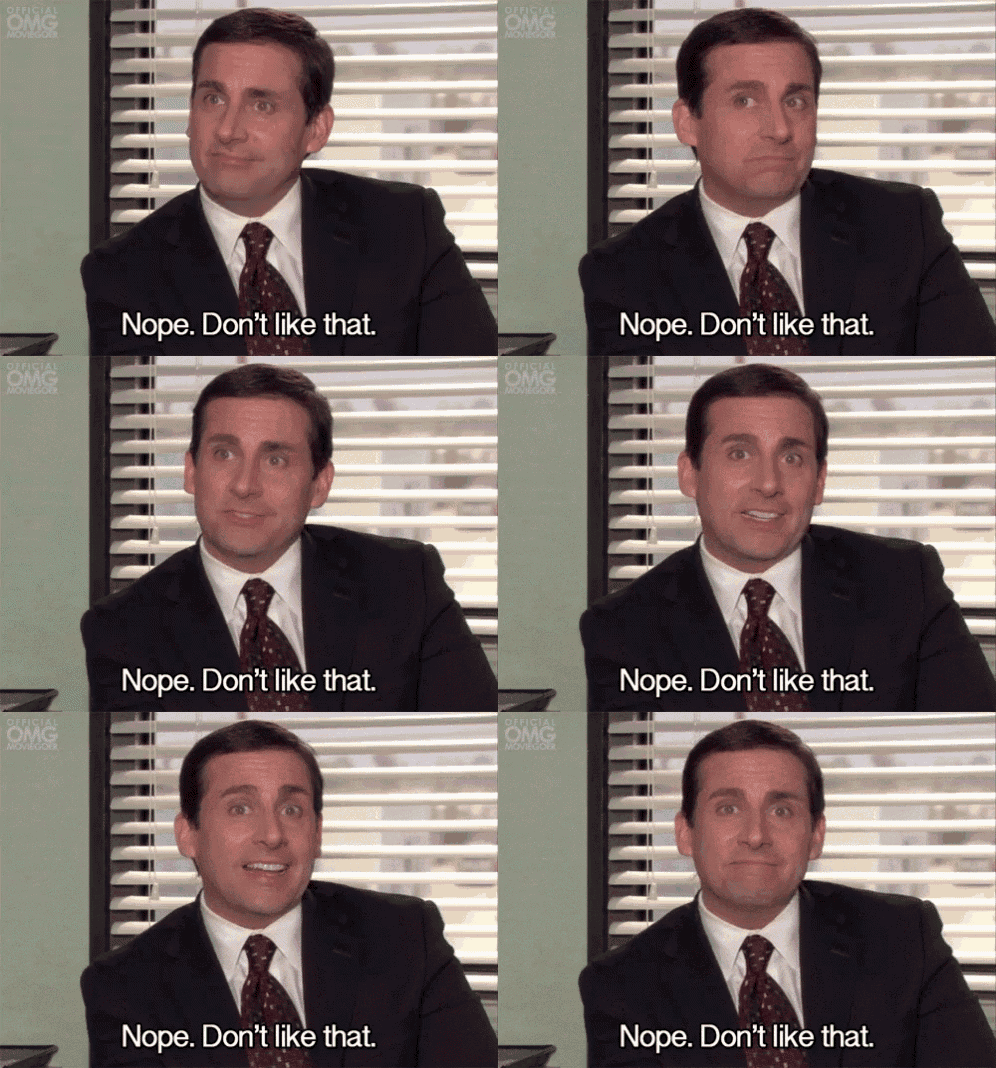
There are MANY reasons why accountability makes leaders squeamish. It’s almost always equated with punishment—meaning, it’s often introduced only when things go wrong. What’s more, it’s commonly misused as a tool to “call someone out,” which is a great way to create a negative & fearful environment.
Part of the other reason accountability gets a bad rep is that it’s SO subjective. What does it truly mean to hold someone accountable, anyway? And…am I good at it? So many times—especially as a new leader years ago—I never felt like I “did” accountability right. Depending on the day, the person, or the situation, I’d either come across as too soft (cue me saying something like, “It’s okay, I know you’re busy, just try to keep it in mind next time!” while quietly hoping things would magically change)...
…or I’d overcorrect & come in WAY too intense (i.e. introducing “accountability” only once I was already frustrated, which meant it landed more like a reprimand than support).

Neither felt great, & neither drove results.
Here’s what I’ve learned since then, & what we see over & over again in our work with middle managers: Most accountability issues aren’t people issues. They’re clarity issues.
One of my favorite lines we teach inside The Perk’s Middle Manager Protocol is, “If it lives in your head, it’s a wish, not an expectation.”
OOF. So, so true. Every time I had said as a leader, “I wish my team would be more proactive,” or “I wish they’d take more ownership,” I was setting everyone up to miss the mark. Because how can someone be accountable to your expectations if you don’t…make your expectations known?
Clear expectations give people something solid to stand on. They create shared understanding around what success looks like, why it matters, & who owns what.
When expectations are fuzzy, or unspoken, two things happen: leaders end up frustrated, & teams feel confused or get defensive. That means accountability conversations feel WAY harder than they need to be.

But when expectations are explicit, & agreements are visible, accountability starts to feel less like confrontation & more like forward momentum.
So, that’s the first reframe I personally had to learn. The second one is this: accountability isn’t about avoiding mistakes—it’s about making new ones.
Mistakes are inevitable. Work is complex. Priorities shift. People are human. We’re ALL going to screw up. What accountability helps to prevent isn’t all mistakes, but the same mistakes that show up time & time again.
Teams repeat the same mistakes not because they’re lazy, or don’t care. They get repeated because expectations weren’t clear, or ownership wasn’t spelled out, or feedback wasn’t given. Sometimes, it’s simply because no one paused long enough to ask, “What did we learn from this & what needs to change next time as a result?”
Strong accountability creates learning loops. It gives teams permission to try new ways of problem-solving, reflect, adjust, & move forward with better information than they had before. Missed expectations become data rather than a pathway to shame or blame.
Which leads me to the third way I had to reframe accountability as a leader: as much as you think accountability starts with your team, it doesn’t. It starts with you.

In practice, accountable leaders consistently do four things:
They make expectations explicit—early & often. That means not relying on hints or assumptions. They clearly name what success looks like, what the outcome is (not just the task), whenit’s due, & who owns it.
They hold the work accountable, not the person. When something is missed, they don’t jump to character judgments or stories about motivation. Instead of thinking, “Oh, they’re not reliable,” or “They don’t care,” they instead ask: “I wonder what wasn’t clear?” or “I’m curious what got in the way?”
They follow through on their own commitments, visibly. They close loops, they revisit what they saidthey’d do & they name when priorities shift, instead of moving the goalposts & not telling anyone about it. This signals to their team that accountability matters for EVERYONE.
They respond to misses consistently, not emotionally. They don’t let things slide for weeks & then suddenly crack down, & they don’t apply different standards depending on stress, mood, or who’s involved. Missed expectations are addressed calmly, directly & with a clear “Here’s what’s next.”
Before you can build a culture of accountability, your team needs to experience accountability in a way that’s consistent.
That’s exactly why accountability is a core pillar of the Middle Manager Protocol—and why it’s the focus of our February Culture Community session. Make sure to join us on the last Thursday of the month for “Accountability that Drives Results” (more details on that below!).
Just want to leave you with one important thing: Accountability isn’t synonymous with “being the bad guy.” When done right, it’s all about clarity, & giving your team a fair shot at getting it right. Do that, & you’re…gonna be golden.

(Sorry—had to get a K-Pop Demon Hunters GIF in there somewhere.)
You’re amazing!

What to Do When “Obvious” Expectations Aren’t Obvious
In a recent workshop session, a leader of a team shared what felt like a simple expectation: “Cameras should be on during Zoom meetings.”
Once the team talked it through, it turned out that everyone was holding a different version of that expectation in their head:
- Some people thought it only applied to large meetings.
- Others thought it mattered most in one-on-ones.
- One person shared that they intentionally keep their camera off while multitasking as a courtesy.
- Another leader explained that having cameras on was essential for accessibility reasons.
Same expectation—completely different interpretations. And NONE of them were wrong. It was that the expectation was ambiguous, so accountability was…the same.
Think about a recent expectation or accountability measure you had with your team. Ask yourself:
Is this expectation actually clear and shared?
Would two different people on your team explain what “good” looks like in the same way?
Have I named when this applies, why it matters, & what success looks like?
If the expectation still lives in your head—or if people could reasonably interpret it differently—it’s not something you can hold someone accountable to yet.
Accountability gets a lot easier when expectations are explicit enough that everyone knows what they’re being accountable for. ☺️
Teams large & small love working with The Perk!


SEE results in action!
GE HealthCare, building next level leaders.
Focus on building confident, compassionate leaders, & developing high-trust teams takes innovative, world-renowned healthcare company to the next level.

About The Perk
We're a premiere leadership & culture development studio.
The skills your leaders need today are very different from the ones they needed 5 years ago. We equip leaders with the skills they need to confidently & effectively lead their teams now & going forward.
And we have quite a lot of fun doing it!